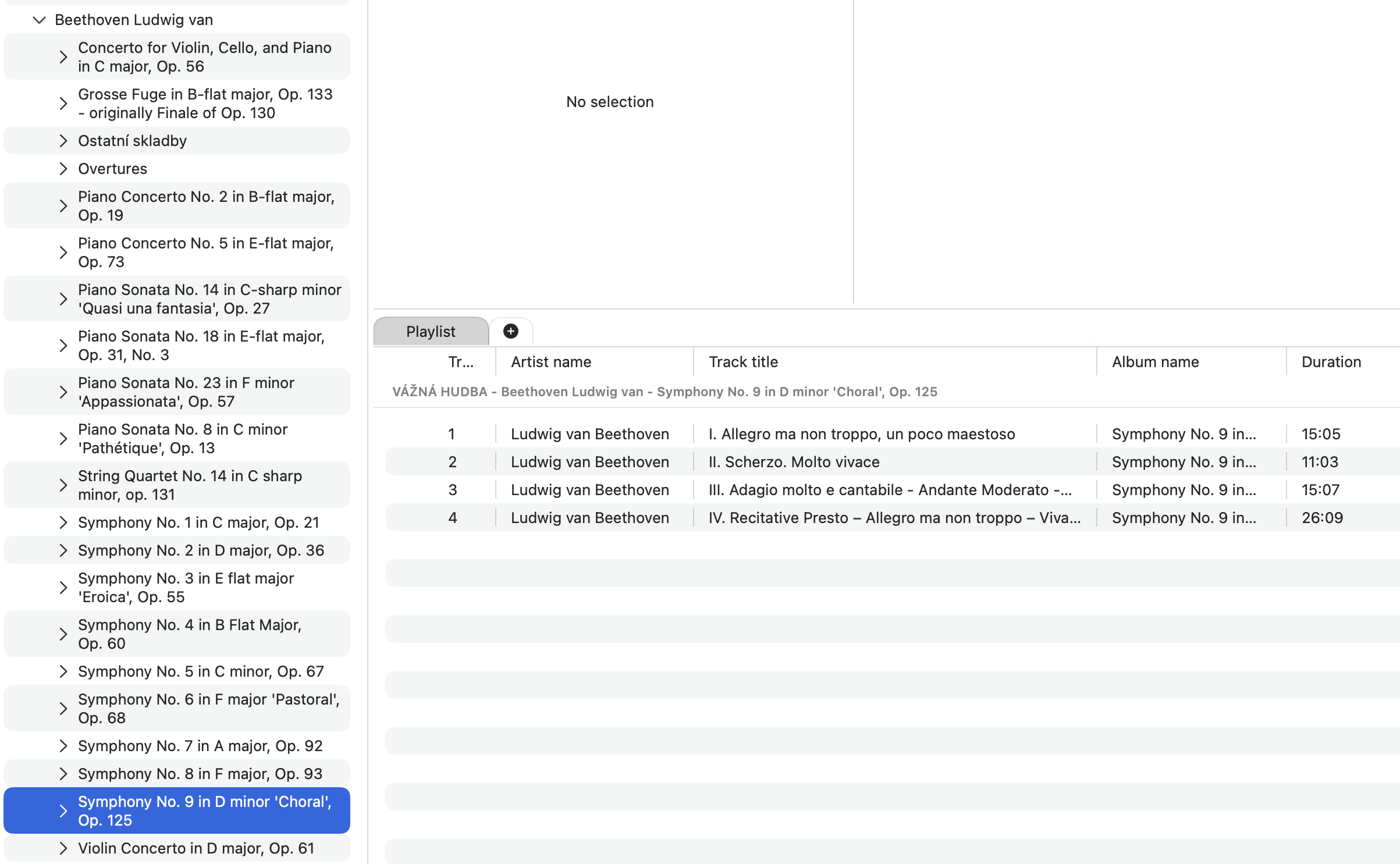
Today Fibich moves beyond single-track playback and adds a place to build a listening session.
Recently, the first playlist implementation landed in the app. It is still early, but it changes the rhythm of using Fibich. Instead of only selecting something from the library and playing it, there is now a dedicated space where tracks can gather, wait their turn, and become part of a longer flow.
That matters for a local music player.
A playlist turns a collection into a listening session. It might hold a few lossless albums, a folder of live recordings, or tracks from different artists, formats, and years.
The library browser is now becoming one side of the experience, and the playlist is becoming the other. The app can begin to answer a more useful question: not only "what music do I have?" but "what do I want to listen to now?"
Today's work also improves how playlist items appear. A hi-fi library becomes hard to navigate when every track looks like a filename, so the playlist now shows more metadata such as title, artist, and album.
This is one of those parts of the app where the goal becomes clearer through use. Playback needs controls. Once playback exists, the next challenge is trust. Can I select music from my library? Can I see what is queued? Can I understand what is in front of me? Can the app keep enough context that I do not feel lost?
Fibich can now answer some of those questions.
I also simplified some library item data in preparation for persistence. If playlists are going to survive relaunches, the data model needs stable, practical records.
The current version is still only a beginning. Playlists will need more power: better sorting, selection, deletion, persistence, drag and drop, and eventually multiple playlists. But today the basic idea is alive inside the app.
Fibich can play music, and now it can begin to hold a queue of music with more intention.
This brings Fibich closer to a native macOS player with wide format support, readable metadata, library organization, and useful playlists.